
Analogue Paneer: What Is It, Is It Safe & How Is It Different From Dairy Paneer?

K11 Fitness Academy
If you have been following food and health news recently, you may have come across a rather alarming headline:
“Maharashtra bans analogue paneer.”
For many consumers, that immediately raises another question:
What exactly have we been eating when we order paneer?
The confusion is understandable.
Paneer is one of the most familiar foods in the Indian diet. It is particularly important for lacto-vegetarians because it is a convenient, protein-rich food and is frequently recommended as a source of high-quality dairy protein.
So when the words “analogue paneer,” “fake paneer” or “non-dairy paneer” start appearing in the news, it is natural to wonder:
- What is analogue paneer?
- Is analogue paneer the same as fake paneer?
- Is it safe to eat?
- Is it nutritionally equivalent to dairy paneer?
- Why has Maharashtra taken regulatory action?
- And how can consumers know what they are actually buying?
The answer is more nuanced than the headlines suggest.
Because the real issue is not simply whether something looks like paneer.
It is what that product is made of, how it has been manufactured, how it is labelled – and whether the consumer knows what they are actually eating.
What Is Analogue Paneer?
Let’s begin with the word “analogue.”
In the dairy context, FSSAI defines an analogue as a product in which some or all milk constituents are replaced by constituents that are not derived from milk, while the finished product resembles a milk or milk-product in its characteristics or function.
In simple terms:
An analogue is designed to behave like the food it resembles – but it is not necessarily made from the same ingredients.
Analogue paneer may therefore be manufactured using combinations of ingredients such as:
- vegetable oils or fats;
- plant proteins such as soy or pea protein;
- milk solids in some formulations;
- starches;
- stabilisers;
- emulsifiers;
- hydrocolloids and gums; and
- flavouring agents.
FSSAI’s own 2026 Food Safety and Standards Digest specifically describes paneer analogues as products made using combinations such as vegetable oils/fats, palm stearin, starches, milk solids, plant proteins, stabilisers, emulsifiers and flavours to create a cheaper product that mimics the appearance and texture of paneer.
So, is it “fake paneer”?
Not necessarily.
“Fake paneer” is the colloquial term that has become popular in media and social conversations. “Analogue” is the more precise regulatory and technical terminology.
The important distinction is this:
An analogue product is different from traditional dairy paneer. Misrepresenting an analogue product as dairy paneer is a separate and much more serious issue.
Is Analogue Paneer Nutritionally the Same as Dairy Paneer?
This is perhaps the most important question for nutrition professionals.
And the short answer is:
No – not by default.
A product can resemble paneer in appearance, texture and cooking behaviour without providing the same nutritional profile.
Traditional dairy paneer is made from milk. Its proteins are predominantly milk proteins – casein, and it provides a naturally rich source of essential amino acids.
This is one of the reasons paneer has such an important place in the diets of many lacto-vegetarians.
At K11, paneer is recommended because traditional dairy paneer can provide:
- high-quality dairy protein;
- all essential amino acids;
- naturally high leucine content;
- good digestibility;
- calcium and phosphorus;
- high satiety; and
- relatively low carbohydrate content.
So when we recommend paneer as a protein source, we are not recommending a cube of food simply because it resembles paneer. We are recommending it because of what it contains.
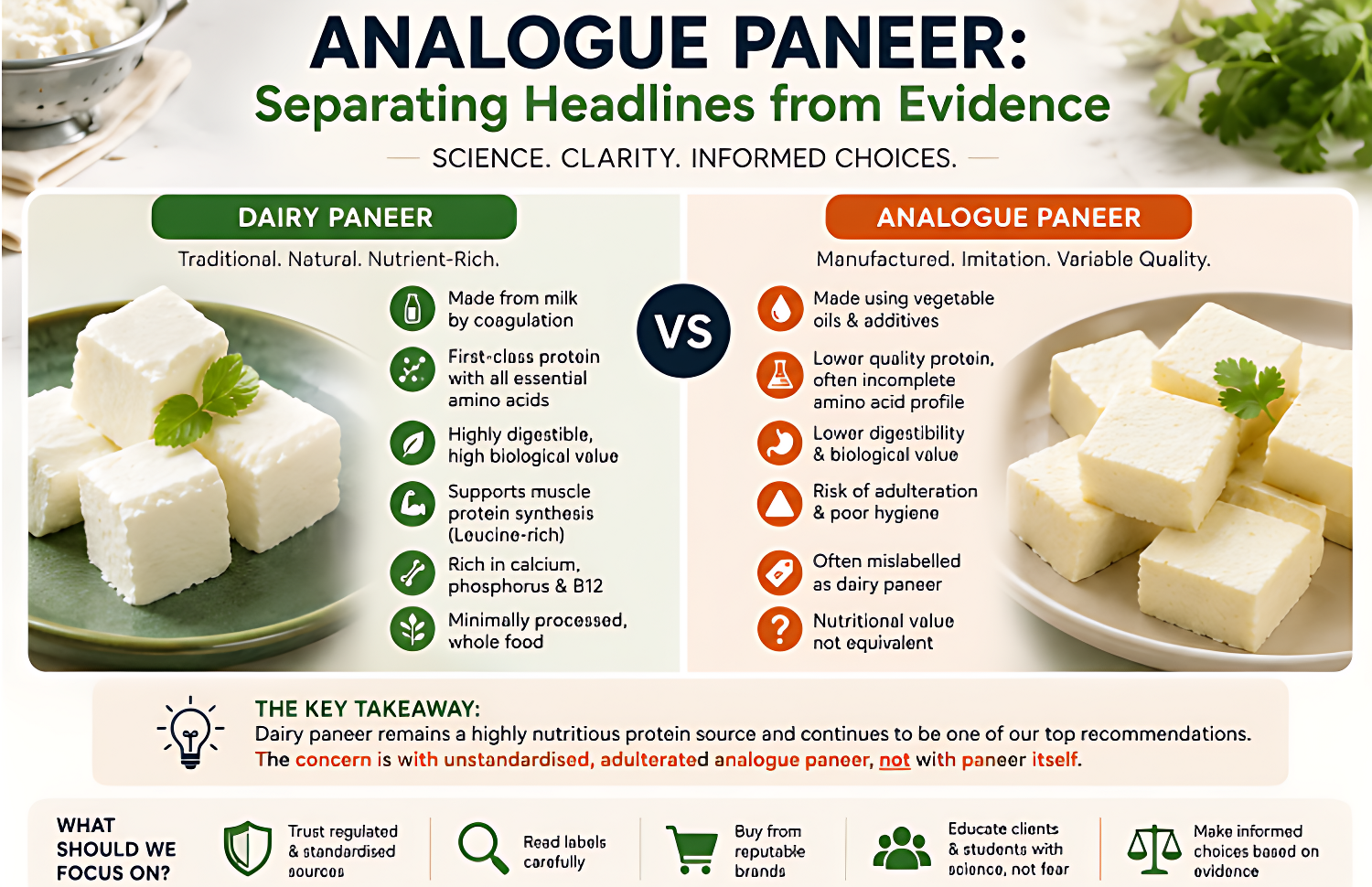
Analogue Paneer vs Dairy Paneer: What Is the Difference?
| Traditional Dairy Paneer | Analogue Paneer | |
| Primary basis | Milk | Non-dairy ingredients may replace some/all milk constituents |
| Protein | Milk protein – Casein | May include plant proteins and/or milk solids depending on formulation |
| Fat | Naturally occurring milk fat | May contain vegetable oils/fats |
| Texture | Produced through milk coagulation | Manufactured to reproduce paneer-like texture |
| Nutritional profile | Relatively consistent as a traditional dairy food | Can vary substantially by formulation |
| Processing | Relatively simple traditional process | Generally more formulation-dependent |
| Consumer expectation | Dairy paneer | Should be clearly identified as an analogue/non-dairy product where applicable |
The important word here is “may.”
Not every analogue formulation is identical.
And that is precisely why we should avoid making sweeping statements about every analogue product without looking at its actual formulation.
What Is Analogue Paneer Made Of?
The formulation can vary, but analogue paneer may contain combinations of:
Vegetable fats and oils
These may be used to replace some or all of the milk fat.
The nutritional implications depend on the specific fat used, its composition and the overall formulation.
Depending on the type of oil and how it is processed, some vegetable fats may be more prone to oxidation during refining, long-term storage or repeated heating. Oxidation can produce unwanted compounds, cause rancidity and reduce the overall quality of the fat.
Plant proteins
Soy, pea and other plant proteins may be incorporated into analogue formulations.
While isolated soy protein is considered a quality plant protein, analogue paneer formulations vary considerably in both protein quantity and quality. Consequently, they should not be assumed to be nutritionally equivalent to traditional dairy paneer.
The quantity, amino acid profile, digestibility and total protein content all matter.
Modified starches
Starches can provide structure and help reproduce the texture required in a paneer-like product.
Their primary role is technological rather than nutritional.
Hydrocolloids, gums and stabilisers
These ingredients can improve texture, consistency, stability and shelf life.
Their presence alone does not make food unsafe. Approved food additives have legitimate technological functions when used within applicable regulatory limits.
But they also do not make an analogue product nutritionally equivalent to traditional dairy paneer.
The Protein Question: Why Does It Matter?
This is particularly relevant if paneer is being used as a major protein source.
Traditional dairy paneer provides milk proteins with a strong essential amino acid profile and naturally high leucine content.
Leucine is particularly relevant because it plays an important role in stimulating muscle protein synthesis.
Analogue paneer formulations, however, can vary significantly in:
- total protein;
- protein source;
- amino acid composition; and
- digestibility.
Therefore:
You cannot assume that 100 g of something called “analogue paneer” provides the same nutritional value as 100 g of traditional dairy paneer.
The nutrition label and ingredient list matter.
What About the Fat?
This is another area where simplistic headlines can mislead.
The fact that an analogue product uses vegetable fat does not, by itself, tell us everything about its health impact.
Different vegetable fats have different fatty acid compositions and different levels of stability.
The sensible approach is to assess the actual fat source, composition, processing and overall dietary context rather than demonising an entire category of fats.
For nutrition professionals, this is an important distinction:
We should evaluate ingredients scientifically – not emotionally.
The Bigger Concern: Adulteration
This is where the conversation becomes much more serious.
There is a difference between:
A clearly labelled analogue product
and
A substandard or adulterated product being represented as something it is not.
The recent regulatory action in Maharashtra followed testing and surveillance that identified products failing prescribed standards, including products classified as unsafe. Current reporting has also highlighted concerns around adulteration and substitution of milk fat with vegetable fat in some failed samples.
That is not simply a question of whether a product is “processed.”
It is a question of:
quality + safety + standards + honesty.
The Other Issue We Need to Talk About: Transparency
Imagine you go to a restaurant and order:
Paneer tikka.
What do you expect to receive?
Most people would naturally assume that the paneer is a traditional dairy paneer.
But if an analogue or non-dairy substitute is being used, the consumer may have a very different nutritional product on their plate.
This is why labelling and disclosure matter.
FSSAI’s current regulatory material specifically addresses the use of dairy analogues in food-service establishments and the need for the nature of the ingredient to be communicated to consumers.
The issue is therefore not simply:
“Is analogue paneer bad?”
The better question is:
“Does the consumer know that it is an analogue product?”
Because informed choice is fundamental to food labelling.
What About Paneer Served in Restaurants?
This is one of the questions consumers are asking most frequently.
And there is no responsible way to say that all restaurant paneer is analogue or that all restaurant paneer is dairy paneer.
The answer depends on the establishment, its procurement practices and the products it uses.
In fact, FSSAI’s April 2026 notice specifically instructs centrally licensed food-service establishments to ensure procurement teams and chefs avoid using cheese analogue as paneer and to maintain appropriate records and verification.
So rather than assuming, consumers should favour establishments that are transparent about their ingredients and food sourcing.
Can You Identify Analogue Paneer at Home?
This is where we need to be careful.
The internet is full of “home tests” claiming that you can identify fake paneer simply by boiling it, heating it or adding various substances.
Some of these claims are widely circulated online, but a visual or kitchen test should not be treated as a definitive analytical method for establishing whether a product is compliant, adulterated or nutritionally equivalent to dairy paneer.
The most reliable first step for a packaged product is much simpler:
Read the label.
Look for:
- the product name;
- ingredient list;
- protein content;
- fat source;
- manufacturer;
- FSSAI details; and
- any declaration indicating that the product is an analogue or non-dairy product.
For food-service establishments, transparency in menus and procurement is equally important.
When in doubt, ask.
Should You Stop Eating Paneer?
No.
The recent discussion should not create unnecessary fear around traditional dairy paneer.
Traditional dairy paneer remains a valuable protein-rich food, particularly for lacto-vegetarians.
The regulatory action is not a reason to conclude that:
“Paneer is unhealthy.”
Rather, it is a reason to become more discerning about which paneer you are buying and what is actually in it.
At K11, our recommendation remains straightforward:
Don’t fear paneer. Understand the paneer.
Three Questions Every Consumer Should Ask
Instead of asking only:
“Is this real or fake?”
Ask three better questions:
- What is this product made from?
- Is it clearly labelled and accurately represented?
- Does it actually provide the nutritional value I am expecting from paneer?
These questions shift the conversation from fear to informed decision-making.
And that is exactly where nutrition education should take us.
The K11 Takeaway
The analogue paneer controversy is ultimately about much more than one food.
It is a reminder that appearance does not tell us everything about nutrition.
A food can look like paneer, cook like paneer and taste reasonably like paneer
and still have a very different ingredient composition and nutritional profile.
At the same time, we should not turn every analogue product into a villain simply because it is manufactured differently.
The scientifically responsible approach is to look at:
composition.
processing.
protein quality.
fat source.
food safety.
labelling.
and transparency.
Traditional dairy paneer continues to be a valuable, protein-rich food for lacto-vegetarians.
The concern arises when a substitute is substandard, adulterated, unsafe or inadequately disclosed to the consumer.
Because ultimately, the question isn’t:
“Does it look like paneer?”
The better question is:
“Does it deliver what we expect when we choose paneer as a high-quality protein source?”
That is the question worth asking.
And that is where the conversation should begin.
Frequently Asked Questions
1. What is analogue paneer?
Analogue paneer is a manufactured product designed to resemble traditional paneer but in which some or all milk constituents may be replaced by non-milk ingredients such as vegetable fats, plant proteins, starches and other functional ingredients. FSSAI recognises “analogue in the dairy context” as a defined category.
2. Is analogue paneer the same as fake paneer?
Not necessarily. “Fake paneer” is a commonly used consumer/media term. “Analogue” is the more precise technical term for a product designed to resemble a dairy product using non-dairy constituents. The more serious issue arises when an analogue or adulterated product is misrepresented as traditional dairy paneer.
3. Is analogue paneer safe?
Safety depends on the specific product, formulation, manufacturing practices and compliance with applicable food standards. An analogue should not automatically be assumed to be unsafe simply because it is an analogue. However, substandard or adulterated products can pose food-safety concerns.
4. Is analogue paneer healthy?
It cannot be assessed as a single nutritional category because formulations vary. It should not automatically be assumed to be nutritionally equivalent to traditional dairy paneer. The ingredient list and nutrition information need to be evaluated.
5. What is the difference between analogue paneer and dairy paneer?
Traditional dairy paneer is made from milk through coagulation. Analogue paneer uses non-milk constituents to reproduce some of the characteristics of paneer. Consequently, the two can have substantially different ingredient compositions and nutritional profiles.
6. What is analogue paneer made from?
Depending on the formulation, analogue paneer may contain vegetable fats/oils, plant proteins, milk solids, starches, stabilisers, emulsifiers, hydrocolloids and flavouring agents. FSSAI’s 2026 Food Safety and Standards Digest specifically describes these types of ingredients in paneer analogues.
7. Can restaurants use analogue paneer?
Food-service establishments need to comply with applicable food-safety and labelling requirements. FSSAI has specifically issued directions concerning the use of cheese analogues as paneer and the need for proper naming and disclosure.
8. Should I stop eating paneer because of the recent news?
No. The recent regulatory action should not be interpreted as a warning against traditional dairy paneer. The important distinction is between traditional dairy paneer and a substitute or analogue product, and whether the product is safe, compliant and accurately represented.
– Ms. Shilpi Arora,
Researcher & Sr. Lecturer, K11 Fitness Academy
Related Blogs
K11 Fitness Academy
Is Nutrition and Dietetics a Good Course for a Successful Career?
Read More

K11 Fitness Academy
How To Become A Nutritionist: Duties, Salary, and Skills
Read More

K11 Fitness Academy
Popular Diets and Trends
Read More

K11 Fitness Academy
The Rise and Scope of Female Personal Trainers and Fitness Professionals: Breaking Barriers in the Industry
Read More